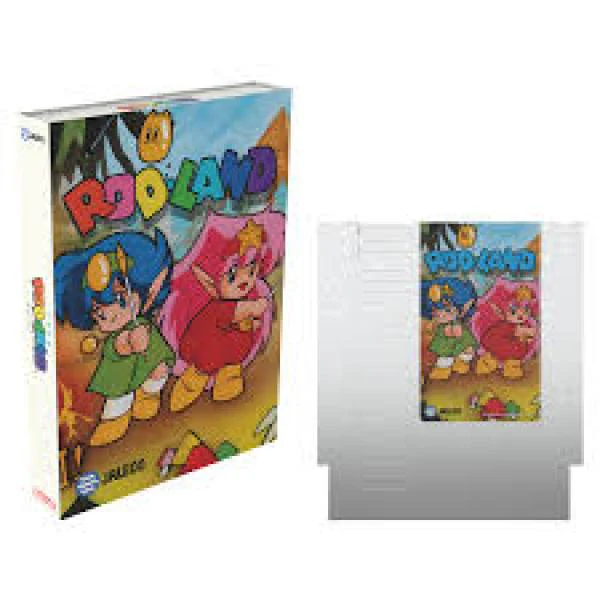
NES Rod Land - Retro-bit version - BRAND NEW & SEALED
- First official physical release in North America
- Enchanted 8-bit cartridge for NES® consoles
- Exclusive Acrylic Cartridge Display Stand
- Numbered hardcover magnetic cartridge packaging
- Full-colored instruction manual
- Region free - Designed to work in both PAL and NTSC regions (60Hz &
50Hz), Compatible with Nintendo NES and many third party clone consoles.
Description:
The once calm and quiet Fairy Village has been attacked! Dark magic has turned the normally docile wildlife into hostile fiends and Tam and Rit have had their mother kidnapped!
They will need to don the magic rods and rainbow shoes that their late father passed down to them and venture into Maboots Tower to rescue her.
Venture through 40 scenes and more with up to two players in this first official release in North America of this classic arcade port on the NES®.
History of Rod Land
Released in April 1990, Yōsei Monogatari Rod Land (妖精物語ロッドランド) hit Japanese arcades. Developed by Jaleco, it took the concept of a single-screen platformer (such as Bubble Bobble or Burger Time) and presented it with colorful graphics and a classic soundtrack.
It became a popular title in the arcades and in order to capitalize on the growing home console market, Jaleco released ports on the Famicom and Game Boy in Japan. With the growing home console market, Jaleco worked with London-based The Sales Curve (later SCi) to publish ports on the Amiga, Commodore 64, ZX Spectrum, and other home and PC consoles for Europe.
Now titled Rod Land (sometimes Rod-Land), these ports were faithful to the original arcade, although some versions did add new stages, backgrounds, and even the ability to jump.
In 1992, ports for the NES® and Game Boy® appeared but they were limited to Italy, the Netherlands, and Spain. The minimal amount of text made it easy to port, however, it never saw a physical release in the United States. This was possibly due to the SNES® launching in 1990 and Nintendo of America pulling publishing support for the aging NES® to focus on the newer console.
Original: $99.99
-70%$99.99
$30.00NES Rod Land - Retro-bit version - BRAND NEW & SEALED
- First official physical release in North America
- Enchanted 8-bit cartridge for NES® consoles
- Exclusive Acrylic Cartridge Display Stand
- Numbered hardcover magnetic cartridge packaging
- Full-colored instruction manual
- Region free - Designed to work in both PAL and NTSC regions (60Hz &
50Hz), Compatible with Nintendo NES and many third party clone consoles.
Description:
The once calm and quiet Fairy Village has been attacked! Dark magic has turned the normally docile wildlife into hostile fiends and Tam and Rit have had their mother kidnapped!
They will need to don the magic rods and rainbow shoes that their late father passed down to them and venture into Maboots Tower to rescue her.
Venture through 40 scenes and more with up to two players in this first official release in North America of this classic arcade port on the NES®.
History of Rod Land
Released in April 1990, Yōsei Monogatari Rod Land (妖精物語ロッドランド) hit Japanese arcades. Developed by Jaleco, it took the concept of a single-screen platformer (such as Bubble Bobble or Burger Time) and presented it with colorful graphics and a classic soundtrack.
It became a popular title in the arcades and in order to capitalize on the growing home console market, Jaleco released ports on the Famicom and Game Boy in Japan. With the growing home console market, Jaleco worked with London-based The Sales Curve (later SCi) to publish ports on the Amiga, Commodore 64, ZX Spectrum, and other home and PC consoles for Europe.
Now titled Rod Land (sometimes Rod-Land), these ports were faithful to the original arcade, although some versions did add new stages, backgrounds, and even the ability to jump.
In 1992, ports for the NES® and Game Boy® appeared but they were limited to Italy, the Netherlands, and Spain. The minimal amount of text made it easy to port, however, it never saw a physical release in the United States. This was possibly due to the SNES® launching in 1990 and Nintendo of America pulling publishing support for the aging NES® to focus on the newer console.
Product Information
Product Information
Shipping & Returns
Shipping & Returns
Description
- First official physical release in North America
- Enchanted 8-bit cartridge for NES® consoles
- Exclusive Acrylic Cartridge Display Stand
- Numbered hardcover magnetic cartridge packaging
- Full-colored instruction manual
- Region free - Designed to work in both PAL and NTSC regions (60Hz &
50Hz), Compatible with Nintendo NES and many third party clone consoles.
Description:
The once calm and quiet Fairy Village has been attacked! Dark magic has turned the normally docile wildlife into hostile fiends and Tam and Rit have had their mother kidnapped!
They will need to don the magic rods and rainbow shoes that their late father passed down to them and venture into Maboots Tower to rescue her.
Venture through 40 scenes and more with up to two players in this first official release in North America of this classic arcade port on the NES®.
History of Rod Land
Released in April 1990, Yōsei Monogatari Rod Land (妖精物語ロッドランド) hit Japanese arcades. Developed by Jaleco, it took the concept of a single-screen platformer (such as Bubble Bobble or Burger Time) and presented it with colorful graphics and a classic soundtrack.
It became a popular title in the arcades and in order to capitalize on the growing home console market, Jaleco released ports on the Famicom and Game Boy in Japan. With the growing home console market, Jaleco worked with London-based The Sales Curve (later SCi) to publish ports on the Amiga, Commodore 64, ZX Spectrum, and other home and PC consoles for Europe.
Now titled Rod Land (sometimes Rod-Land), these ports were faithful to the original arcade, although some versions did add new stages, backgrounds, and even the ability to jump.
In 1992, ports for the NES® and Game Boy® appeared but they were limited to Italy, the Netherlands, and Spain. The minimal amount of text made it easy to port, however, it never saw a physical release in the United States. This was possibly due to the SNES® launching in 1990 and Nintendo of America pulling publishing support for the aging NES® to focus on the newer console.